Investigation
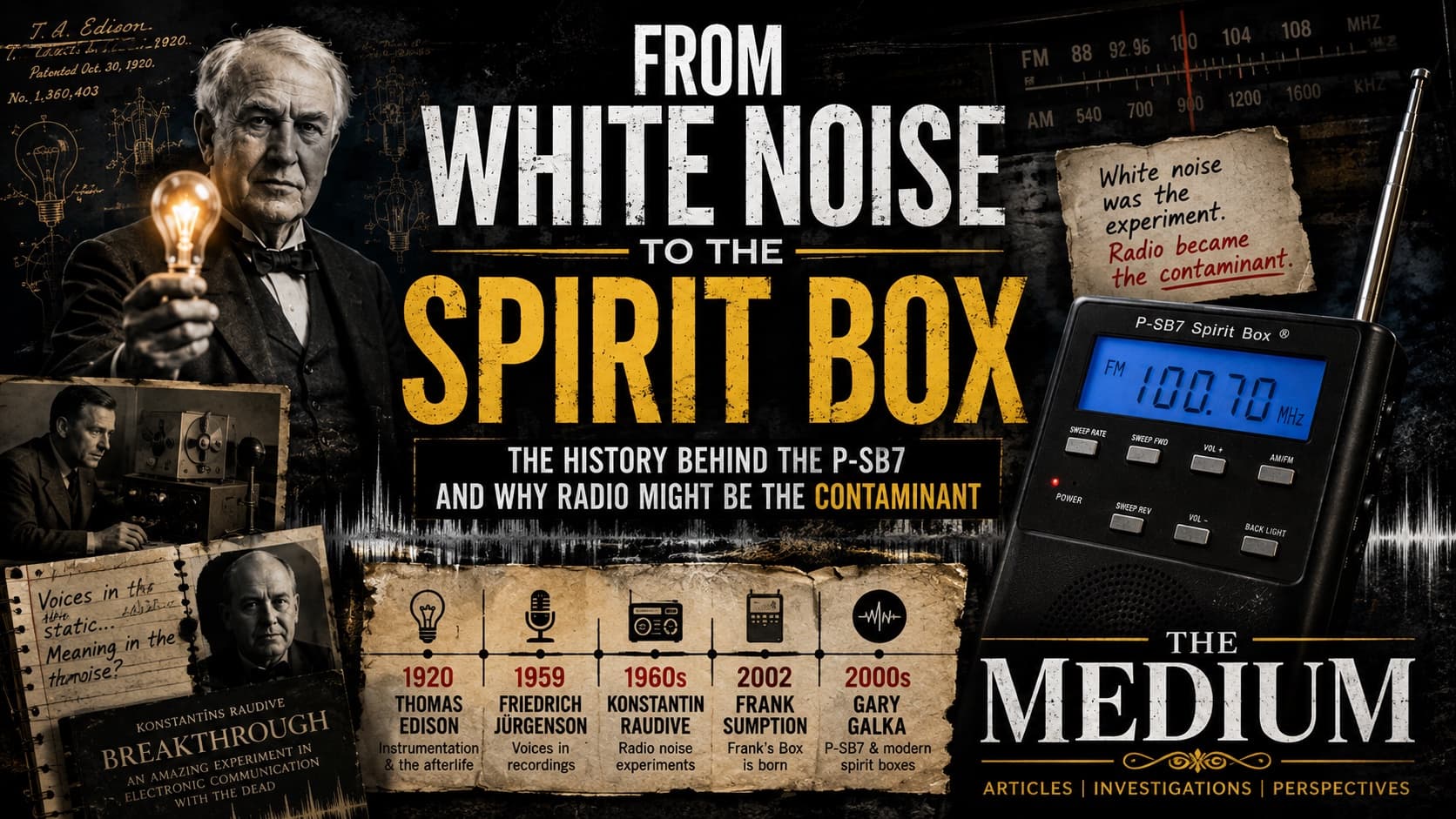
From White Noise to the Spirit Box
August 19, 2026 · Franki Cambeletta · 11 min read
Today, walk into almost any paranormal investigation and eventually someone will pull out a spirit box.
Turn it on and you know the sound immediately.
CH-CH-CH-CH-CH-CH-CH.
Fragments of music. Half a syllable. Static. A DJ. More static. Maybe a word.
Then somebody asks:
"Did you say my name?"
But here's the question we became much more interested in:
Why are we scanning radio stations in the first place?
Because when you trace the history of electronic spirit communication backward, the P-SB7 isn't where this experiment started. Not even close.
The story begins with a much simpler proposition: if some form of consciousness survives death, could technology detect something we cannot?
And eventually that question became intertwined with another fascinating idea: could an anomalous voice emerge from noise?
That distinction matters. Because somewhere along the road from white noise to the modern spirit box, we introduced something into the experiment that is already extraordinarily good at producing human voices.
Radio.
1920: Thomas Edison Wants an Instrument
Thomas Edison belongs in this history, but probably not in the way paranormal mythology sometimes presents him. There are countless stories online about Edison's mysterious "Spirit Phone." The documented history is more interesting.
In October 1920, Edison discussed the possibility of developing an extremely sensitive instrument that might test whether personalities surviving bodily death could exert some measurable influence. This wasn't merely folklore appearing decades later.
The Thomas A. Edison Papers at Rutgers University catalogs two relevant interviews from 1920:
- How to Communicate with the Next World — The American Magazine
- Edison's Views on Life and Death — Scientific American, October 30, 1920
Edison wasn't announcing that he'd successfully spoken with a ghost. That's an important distinction. He was discussing an experimental apparatus. Contemporary reporting described his proposed instrument as something capable of magnifying an extremely small influence into something measurable.
In other words, the proposition was essentially: if the phenomenon exists, build an instrument capable of detecting it.
That's a philosophy we can get behind. Build it. Test it. Control the variables. Try to break it. And if it survives, test it again.
Reference material: Thomas A. Edison Papers, Rutgers · Edison's Published Articles & Interviews · Scientific American: Edison's Views on Life and Death (1920)
1959: Friedrich Jürgenson Records the Birds
The next major chapter begins almost four decades later with Swedish artist and filmmaker Friedrich Jürgenson.
In 1959, Jürgenson was recording birdsong when he discovered what he interpreted as human voices appearing on his recordings. One of the most famous accounts involved a voice he believed belonged to his deceased mother.
Initially, Jürgenson considered ordinary explanations, including radio transmission. But he continued experimenting with recording equipment and eventually incorporated radio into his work.
Whether Jürgenson's voices were paranormal is not something we're declaring here. What matters is the experimental architecture. He wasn't walking through an abandoned building carrying a commercial spirit box. He was recording. Listening. Repeating. Trying different methods.
The phenomenon that would eventually become known as Electronic Voice Phenomena — EVP — was taking shape. And that leads us to one of the most important people in this entire story.
The 1960s: Konstantin Raudive and the Noise
Latvian psychologist and writer Konstantin Raudive became fascinated by Jürgenson's experiments and began conducting his own. Raudive reportedly accumulated an enormous collection of recordings and developed several methods for attempting to capture voices. His work became internationally known through the English-language publication of Breakthrough in 1971.
Three of the methods attributed to Raudive are particularly important:
- Microphone Method — Allow a recorder to run without intentional speech and examine the recording afterward.
- Radio Method — Record the white noise produced by a radio not tuned to a broadcasting station.
- Diode Method — Use a diode / crystal-receiver arrangement that, again, was not intentionally tuned to a station.
Read that second one again. A radio not tuned to a broadcasting station.
That's extremely important to the modern spirit-box conversation. The experiment wasn't originally how quickly can we scan through as many radio stations as possible? It was can apparent information emerge from noise?
Those are not identical experiments.
White Noise Becomes the Canvas
This is where the underlying hypothesis gets fascinating. White noise contains random acoustic information across a broad range of frequencies. If you believe the paranormal hypothesis, perhaps an unknown mechanism could manipulate that noise into recognizable speech.
If you're skeptical, there's another extremely important possibility: auditory pareidolia.
Human brains are magnificent pattern-recognition machines. Give us ambiguous information and we search for something meaningful inside it. Faces in clouds. Shapes in darkness. Words in noise.
And this isn't merely a skeptical talking point. A 2015 study published in Applied Cognitive Psychology tested perceptions of purported EVP and ambiguous auditory stimuli. Researchers found that telling participants the experiment concerned paranormal EVP increased reports of hearing voices in ambiguous material — and agreement about what those supposed voices actually said was low.
That's exactly why controlled experiments matter. The paranormal explanation and the psychological explanation make different predictions. So design experiments capable of separating them. Don't be afraid of the skeptical explanation. Test it.
Reference: Nees & Phillips, Auditory Pareidolia (Applied Cognitive Psychology)
Then Somebody Put a Radio in the Experiment
Here's where the family tree takes a major turn. Early EVP experimentation largely involved recording and reviewing audio. Noise became one proposed medium. Radio static became another.
But eventually experimenters began using rapidly changing radio frequencies themselves. That changed the experiment. Because a commercial radio spectrum doesn't contain only random noise. It contains:
- People talking, news anchors, commercials, song lyrics
- Station identification, talk radio, weather reports
- Telephone numbers, names
- Individual syllables, complete words, complete sentences
Suddenly the experimental source material already contains the exact phenomenon we're supposedly trying to detect: human speech.
And that's a problem worth investigating.
2002: Frank's Box
The recognizable ancestor of the modern spirit box appears around 2002 with Frank Sumption. His device became known as Frank's Box, Frank's Spirit Box, or simply the Ghost Box.
Academic discussion of paranormal media technology dates Sumption's initial Frank's Box to 2002 and describes the broader ghost-box concept as using modified or purpose-built radio technology intended to facilitate alleged communication with discarnate entities.
The conceptual jump was enormous. Instead of simply recording ambient sound or listening to untuned radio noise, the device could move through radio frequencies. That created the characteristic chopped-up radio sound modern investigators immediately recognize. And eventually that concept would become commercial paranormal equipment.
Enter Gary Galka
Engineer Gary Galka developed some of the most recognizable equipment in modern paranormal investigation. According to Galka's company, DAS Distribution / Pro Measure, he is the original designer and inventor of the P-SB7, along with instruments including the Mel Meter, REM-POD and subsequent spirit-box designs.
Galka's story is also deeply personal. His company says his paranormal instrumentation work followed the 2004 death of his daughter Melissa and experiences the Galka family interpreted as possible after-death communication.
Whatever conclusion someone reaches about paranormal communication, that context deserves respect. Our investigation isn't an attack on the person who built the equipment. We're interested in something much narrower: what does the equipment actually do?
Reference: Gary Galka / DAS Distribution / Pro Measure
What the P-SB7 Actually Does
Strip away the paranormal terminology and the P-SB7 is fundamentally operating with recognizable radio technology. It receives AM and FM radio and can sweep sequentially through frequencies. Operating instructions describe selectable sweep rates measured in milliseconds, with forward and reverse sweeping through frequency channels.
That's important because the P-SB7 isn't creating a pristine laboratory source of white noise. It's traversing the radio spectrum.
And the manufacturer wants radio reception. The operating instructions specifically advise extending and rotating the telescopic antenna for maximum FM tuner sensitivity, and repositioning the device for better AM sensitivity.
That's where our problem begins.
White Noise Was the Experiment. Radio Became the Contaminant.
This is the question Haunted Garage kept coming back to while testing the SB7. If the underlying theory is that an unknown intelligence can manipulate noise into meaningful information, why introduce commercial broadcasts into that noise?
Because now there are at least two competing sources for an apparent response.
- Hypothesis A — Something anomalous manipulated the available sound and produced an intelligent response.
- Hypothesis B — The sweeping receiver briefly encountered existing broadcast speech that happened to sound responsive to the investigator's question.
- Hypothesis C — The audio was sufficiently ambiguous that the listener's brain interpreted it as meaningful speech. That's auditory pareidolia.
Now we've created an experiment containing: noise + broadcast speech + human interpretation. That's a messy experiment.
Which Brings Us to the Building
One criticism we've encountered is essentially: "Of course the SB7 didn't work well. You were inside a heavily shielded building."
Our test environment included substantial masonry and a metal roof — conditions capable of degrading radio reception. And that's precisely why the result interests us.
We're not claiming the building is a certified laboratory Faraday cage. It isn't. We're saying it provided an environment where ordinary radio reception was significantly impaired.
If the SB7's useful output disappears when ordinary broadcast reception disappears, that raises an obvious experimental question: what was producing the useful output?
Because if the paranormal hypothesis requires radio broadcasts to remain receivable, we've introduced a remarkable condition: the proposed communicator apparently needs access to the exact external source most capable of accidentally generating recognizable human speech.
That's something investigators should want to test. Not avoid.
No, We Didn't Prove Ghosts Don't Communicate Through Electronics
This distinction matters enormously. A failed SB7 experiment does not prove:
- ghosts don't exist,
- EVP is impossible,
- white-noise experimentation is worthless,
- ITC is impossible,
- anomalous electronic communication cannot occur.
It tells us something about this particular experimental method. That's it.
In fact, we're interested in returning closer to the original experiment. Remove the commercial radio stations. Create controlled noise. Ask questions. Record everything. Blind the listeners. Don't tell independent reviewers what they're supposed to hear. Compare their interpretations. Repeat the experiment. Change one variable at a time.
That's how you start separating an interesting observation from a compelling experiment.
The Experiment We Actually Want
Forget the argument over whether you're a "believer" or a "debunker." Those labels aren't useful here. Let's build the experiment. Run multiple conditions:
- Control A — Silence. Ask questions with no generated noise source.
- Control B — White Noise. Generate controlled broadband noise without radio broadcasts.
- Control C — SB7 with Normal RF. Operate the SB7 normally in an environment with strong radio reception.
- Control D — SB7 with Attenuated RF. Run the same device while dramatically reducing available broadcast reception.
Then record every session digitally. Timestamp the questions. Have independent listeners evaluate the responses without knowing the questions beforehand. Better yet, give them multiple possible questions and ask them to determine which question preceded each alleged response.
Now we're testing information. Not vibes.
And That's Where the SB7 Story Gets Interesting
The P-SB7 didn't emerge from nowhere. There's a lineage behind it stretching through more than a century of attempts to apply technology to one of humanity's oldest questions.
- Edison asked whether instrumentation could detect something beyond death.
- Jürgenson recorded unexplained voices.
- Raudive experimented with microphones, diodes and untuned radio noise.
- Frank Sumption introduced the sweeping-radio Ghost Box.
- Gary Galka engineered that general concept into one of paranormal investigation's most recognizable commercial instruments.
And now thousands of investigators use descendants of those ideas every weekend. But popularity doesn't end an experiment. It starts another one.
Because somewhere between Raudive's untuned radio noise and today's rapidly sweeping FM receiver, we added actual broadcasters to an experiment looking for voices.
Maybe that's brilliant. Maybe it doesn't matter. Or maybe, somewhere along the way, we accidentally replaced the experiment with the contamination.
That's what we want to find out.
References & Further Reading
Thomas Edison
- Thomas A. Edison Papers, Rutgers University
- Rutgers: Edison Published Articles and Interviews
- Scientific American: Edison's Views on Life and Death, 1920
Electronic Voice Phenomena
- The Guardian: Blasts from the Past (Jürgenson's experiments)
- Skeptical Inquirer: Electronic Voice Phenomena (Raudive's methods)
Perception & Auditory Pareidolia
Frank's Box / Ghost Box
P-SB7 / Gary Galka
- Pro Measure: Gary Galka and DAS Distribution
- Pro Measure: Paranormal Instrumentation & the P-SB7 Family
About the Author
Franki Cambeletta is a twenty-year veteran of software and technology and the founder of CAMBO, LLC, an agentic-software consultancy serving clients in high-stakes, high-risk environments.
Over his career he has partnered with Fortune 100 and Fortune 500 organizations — among them NASCAR, Bayer, Ameren, the TSA, the U.S. Department of Homeland Security, the NFL, the NHL, and Research In Motion — and has worked as an award-winning filmmaker, podcaster, and advertising creative. He brings that same evidence-first discipline to The Medium's investigations.
We don't approach paranormal equipment with the goal of proving that it works or proving that it doesn't. We ask what the manufacturer or developer says it does. Then we investigate the history, examine the technology, control the variables, and test the claim. Sometimes we debunk the equipment. Sometimes we debunk ourselves. Both are useful results. Because if we're going to claim that technology can communicate with the dead, "it seemed to work" isn't the finish line. It's where the investigation begins.
— The Medium · Haunted Garage