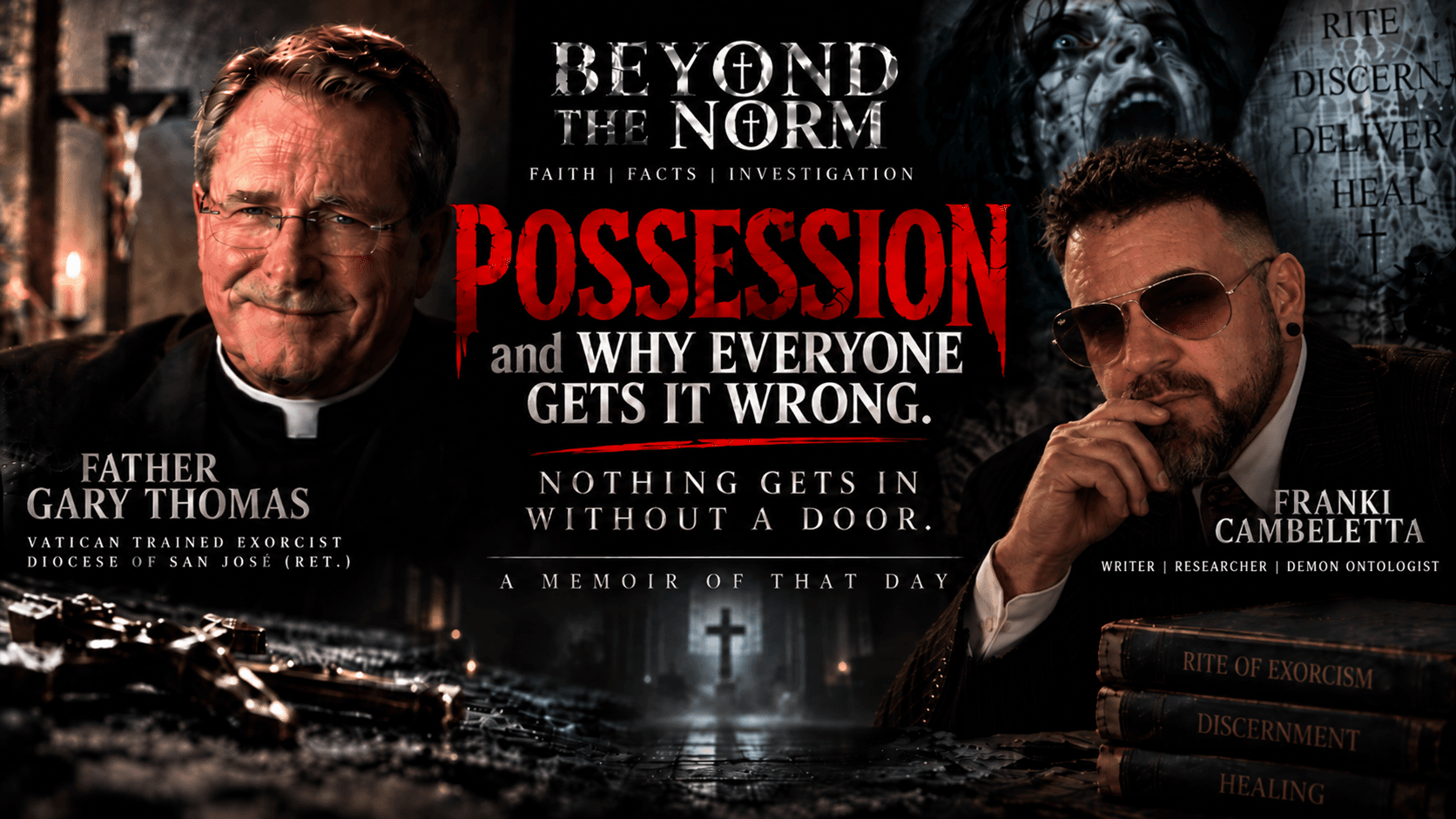
Nothing Gets In Without a Door
September 15, 2026 · The Emmaus Team · 14 min read
Nothing Gets In Without a Door
I spent the day asking a Vatican-trained exorcist how possession actually works. The part I got wrong was the part I was most sure of.
He told me he had until three.
I'd driven to a seminary in Menlo Park with a list of questions I'd been building for months, and the first thing Father Gary Thomas did was take a form off the wall and hand it to me. Not a relic. Not a ritual book. An intake form — the same kind of paperwork you fill out at a new dentist.
That should have told me where this was going.
Father Thomas was the exorcist for the Diocese of San Jose for fifteen years. He trained in Rome in only the second year the course was ever offered, and the writer who sat next to him in that class, Matt Baglio, turned it into a book called The Rite. The movie came after — Anthony Hopkins playing the Capuchin priest Thomas actually apprenticed under. He worked on set for a week. He kept his own name out of the film for as long as he could.
I make paranormal television, and I run a haunted locations. I came in thinking I understood the shape of the thing: a person gets possessed, a priest shows up, there's a fight, somebody wins. Two hours later I had a completely different model — and the strange part is that it's less supernatural than the one I walked in with, not more.
Here is what he actually said.
The first move is to try to prove it isn't demonic
"In the Catholic Church there is an antiphon," he told me. "The exorcist is the ultimate skeptic."
I expected that to be a line. It isn't. It's a workflow.
After the book came out he was getting around ninety calls a week. After the movie it got worse. And almost none of those people got what they were asking for, because — as he put it — "there's a protocol, and we don't do them on request."
The protocol runs in a specific order, and the supernatural is dead last. Medical workup first. Then a clinician — and specifically a practicing Catholic or Christian clinician, because he needs someone who will take the psychiatric explanation seriously and won't reflexively rule out the other one. Only after all of that does he get involved.
While I was sitting there he described walking a woman in Northern California — not even Catholic, a Lutheran — through that exact sequence over the phone. Call your doctor. Get the scans. If nothing turns up, call your diocese, ask for the Vicar General, get referred to a clinician. He wasn't trying to get rid of her. That is the process.
He kept written records on every single person his team ever saw. Of the hundreds who came through, he said the issue was almost always either psychiatric or spiritual, and his job was to find out which before he did anything at all.
The thing I had pegged as a horror-movie profession is mostly triage.
The word he uses more than any other
Once he's past the ruling-out, he's not hunting a demon. He's hunting an entry point.
"The intake largely gives you a lot of information about issues of childhood," he said, "and then a lot of what I call doorways. I'm always listening for doorways."
So the questions are these: What was it like growing up in your home? Tell me about your parents. Your siblings. Any history of drug use, alcohol, other addictions of any kind. Any history of sexual abuse.
That's not an exorcism intake. That's a trauma intake. And then he gave me the number that has stayed with me since.
"Eighty percent of the people who came to me were sexual abuse victims."
Eighty percent.
He calls it a soul wound — borrowing a phrase John Paul II used during the clergy abuse crisis, which is its own kind of honesty coming from a Catholic priest. And he was careful to say the wound alone isn't the mechanism. Most survivors of abuse never come near any of this. The wound is what makes a person reachable. Something else has to open the door.
What opens it
"Satanism, New Age, the occult — those are sort of the engines that really draw the demonic in."
Then he got specific in a way I didn't expect. Shamanism, which he says is far more common than people think. Going to a witch. A séance. Reiki — because, in his reading, the meditation invokes gods that aren't yours to invoke. Ayahuasca. Umbanda, the Afro-Brazilian syncretic practice, which he'd never heard of until a case forced him to learn it. Wicca. Mediums.
But he drew a line I want to be fair to him about, because it's the kind of nuance that gets stripped out when people quote exorcists. He said plainly that Hinduism by itself is not demonic. The problem, in his framework, isn't a religion he disagrees with. It's the act of conjuring — deliberately opening a channel and inviting something through it without knowing what's on the other end.
Doors also come attached to objects. He told me about a woman who came back from a New Age retreat with a bag of things from a bookstore, and started having trouble in her house. He told her to throw all of it out. A couple of weeks later she brought him one item she'd tried to destroy first: a pink plastic fairy figurine. When they broke it open, there was something moulded inside it — an altar, with the head and hands of a priest glued down to it, a stole clearly rendered on the body, and talons underneath.
Somebody built that. Deliberately. Then cast it inside a piece of decor cute enough that nobody would ever look twice.
He kept it for years in a bag in a detached garage, and only ever took it out to show visiting priests what they might be walking into.
And doors get inherited. He talks about generational curses as real and — importantly — breakable. When I described a St. Louis family I've researched for years, six suicides across three generations, he didn't tell me it was a curse. He said it could be, and then said something I've thought about a lot since: "I don't like to overly spiritualize stuff." He asked more questions than he answered.
On curses generally, he was blunt about motive. In every case he's encountered, a curse gets placed for one of two reasons: to manipulate, or to retaliate. Somebody wanted a person in a relationship, or somebody wanted to get even. That's it. It's not cosmic. It's petty, and it's human, and it works on other humans.
The accelerant is loneliness
Here's where he lost me for a second, and then got me completely.
"Demons look for people who have broken relationships or no relationships," he said. "People that are very isolated."
His proof text is the Gerasene demoniac in the fifth chapter of Mark — and when you look at that passage the way he does, the details stop being scenery. The man lives in a cemetery. He's away from everyone. He can't be restrained. The isolation isn't a result of the possession in his reading. It's a precondition.
He mentioned, almost in passing, that during COVID he had families bringing him their kids more than usual. Not for possession. For everything else that happens to a person who has been alone for a year.
It's a ladder, not a light switch
This is the correction I most want to hand to anybody who works in this field, because I had it wrong and I've heard a hundred other people have it wrong.
Possession, to him, has a precise definition: "a gang of demons — there's never one — a gang of demons has largely taken over control of the body of a person."
Two things in that sentence. Never one — always a group, always with a hierarchy. And body. He is explicit that the soul can't be taken, because it's made in the image of God. The body is what's on the table.
But full possession is the top of a ladder, and almost nobody he saw was on the top rung. Below it are oppression and obsession, which he calls lesser degrees, and which look like nothing at all from outside:
"A person could be able to drive a car, raise a family, go to work, and have a demonic attachment."
His working definitions, when I pushed him: "Oppression is more depression and malaise. Obsession is more psychosis-type of stuff."
What that actually looks like in a life is a long history of depression or melancholy that therapy hasn't touched. Wide mood swings. A marriage that broke over it. And a reaction — sometimes the only visible one — when the person walks into a church.
Which brings up the uncomfortable part, and he raised it before I did: most therapists don't believe any of this exists, and he knows it. He wasn't dismissive about that. He just said it makes finding clinicians who will work with him difficult. He wants the psychiatric evaluation. He just wants it from someone who will also call him if it comes back clean.
Why it becomes visible
I'd always assumed manifestation was a demon showing off. He says it's the opposite — it's a demon losing.
"The demonic want us to believe they're not there. So they want to do all they can not to react. The reason that they manifest is because the power of prayer exposes them."
The tells he watches for first are smaller than anything in a movie. The eyes, always the eyes — he asks people to hold his gaze the whole time, and describes a shift, as if the person is suddenly wearing very thick lenses. He called it "a presence beyond the presence," and then apologized for not having better words for it.
Then stiffening in the chair. Fluttering eyes, or eyes going sideways. Lips starting to contort. And then what the team calls casting — dry heaving up thick white mucus, which is why there was always a bucket in the room, and which he reads as a good sign. It means the prayer is working.
The classic signs he names are the ones you've read about: foaming, inordinate strength, speaking a language the person has no competency in, epileptic-type movements of the face and limbs, knowledge of hidden things. He had a woman born in the United States speak Korean, having never spoken a word of it in her life.
And then, almost as an aside, the sentence that undoes most of the mythology around this:
"You don't have to have all six in order to do a formal."
It's not a checklist. It's a judgment call, made by a committee, about a suffering person.
The scale nobody puts on screen
Fifteen years. Hundreds of cases. And the formal Rite of Exorcism — the one every film is about — used on twelve people.
"99% of the people we prayed over and were able to liberate, we did through deliverance. We didn't do it through solemn exorcisms. Everybody thinks it's the solemn rite."
Deliverance prayer. Sessions, usually monthly, sometimes over months. Check in, ask what's better and what's worse, pray, decompress with the team afterward, follow up in a few days. He described working a full day at the parish and then starting at four and finishing at eight, two or three days a week, for fifteen years.
That's the job. The rest is cinema.
And no, you can't do it yourself
I asked the question everybody asks, and I asked it because I genuinely wanted to know: can a person deal with this on their own?
The answer isn't "no, the prayers are secret." The answer is that I'd misunderstood the category. An exorcism isn't a technique. It's a delegated authority — and you can't delegate one to yourself.
Even as the appointed exorcist of his own diocese, he needed his bishop's approval for every single formal exorcism he performed. He described the demonic as, of all things, legalistic — attentive to whether the man in front of them actually holds the authority he's claiming. And he's had priests call him after using the rite without permission, having learned that the hard way.
He won't work alone either. "What I do is very collaborative," he said. "You don't do any of this alone." His team included clinicians, a Spanish-speaking deacon, people he describes as discerners, and someone taking notes.
The Church drew the lay boundary explicitly, and he pointed to the most famous example. Of Ed Warren: "They didn't give him the title of exorcist. They gave him the title of being a demonologist, which is different." He's not hostile to demonologists — he named one he respects — but he holds the line hard: there's a difference between teaching about this and being a practitioner of it.
And the cost of ignoring that isn't theoretical. There's a moment in the rite where the priest lays hands on the person and breathes into their face. Once, when he did it, something breathed back. He should have been prayed over immediately. Instead he had a wedding the next morning, and he passed out receiving the Eucharist. He ended up in an emergency room where they couldn't find anything wrong with him.
"The priest faints at a wedding," he said. "Have you ever heard of such a thing?"
What's left for the rest of us
So if the eviction isn't yours to perform, what is?
Everything to do with the door.
Confession and the state of grace, which he describes almost mechanically — absolution, and then the thing is blocked. When I asked whether going looking for a haunting puts you at risk, he didn't say yes and he didn't say no. He said it depends on whether you're in a state of grace, and whether you're carrying serious unconfessed sin. He wouldn't rule it out, and he wouldn't overstate it.
Renunciation, which is a person's own work even when a priest is running the room. In one case he had a man write down every single thing he'd done, and then spent six hours having him reject, renounce and rebuke all of it, breaking the ties one at a time.
And then the simplest part, which is also the part people skip: throw the object out. Stop the practice. End the relationship that is the doorway. He told one man that if he didn't, all of it would come back.
If I had to compress two hours into one line — mine, not his — it's this:
You can close your own doors. You cannot evict your own tenant.
The part I wasn't expecting
Near the end of our conversation, talking about why these films keep getting made, he said something that reframed the entire afternoon for me.
There's all this drama in the movies, he said. That's what makes them tantalizing. But what people forget is that there's a suffering person in the room.
That's the whole argument, really. The doorway model relocates where the horror lives. It isn't in the demon. It's in the fact that four out of five people who walked into that church were carrying something that happened to them as children — and that the thing he spent fifteen years doing was less like combat than like sitting with somebody, monthly, for as long as it took.
He asked if he could pray over me before I left. I said yes.
He prayed for insulation against anything that might come at me through the work I do. Then he prayed that my faith would hold up, and that I'd get married, and that I'd find my way back to something I'd walked away from a long time ago.
I had come for the mechanics of possession. I got them — a wound, a doorway, isolation, three rungs, a name, a binding, and a door pulled shut behind it.
But I drove home thinking about the bucket they kept beside the chair, and the fact that he considered it a good sign.
Father Gary Thomas served as exorcist for the Diocese of San Jose from 2005 to 2020 and now directs a formation program at St. Patrick's Seminary. This piece is drawn from a two-hour interview recorded for a documentary I'm producing on the gap between the practice of exorcism and the way it gets portrayed. Quotations are transcribed from that recording.