Debunk
The Ghost Box With No Ears
August 22, 2026 · Franki Cambeletta · 8 min read
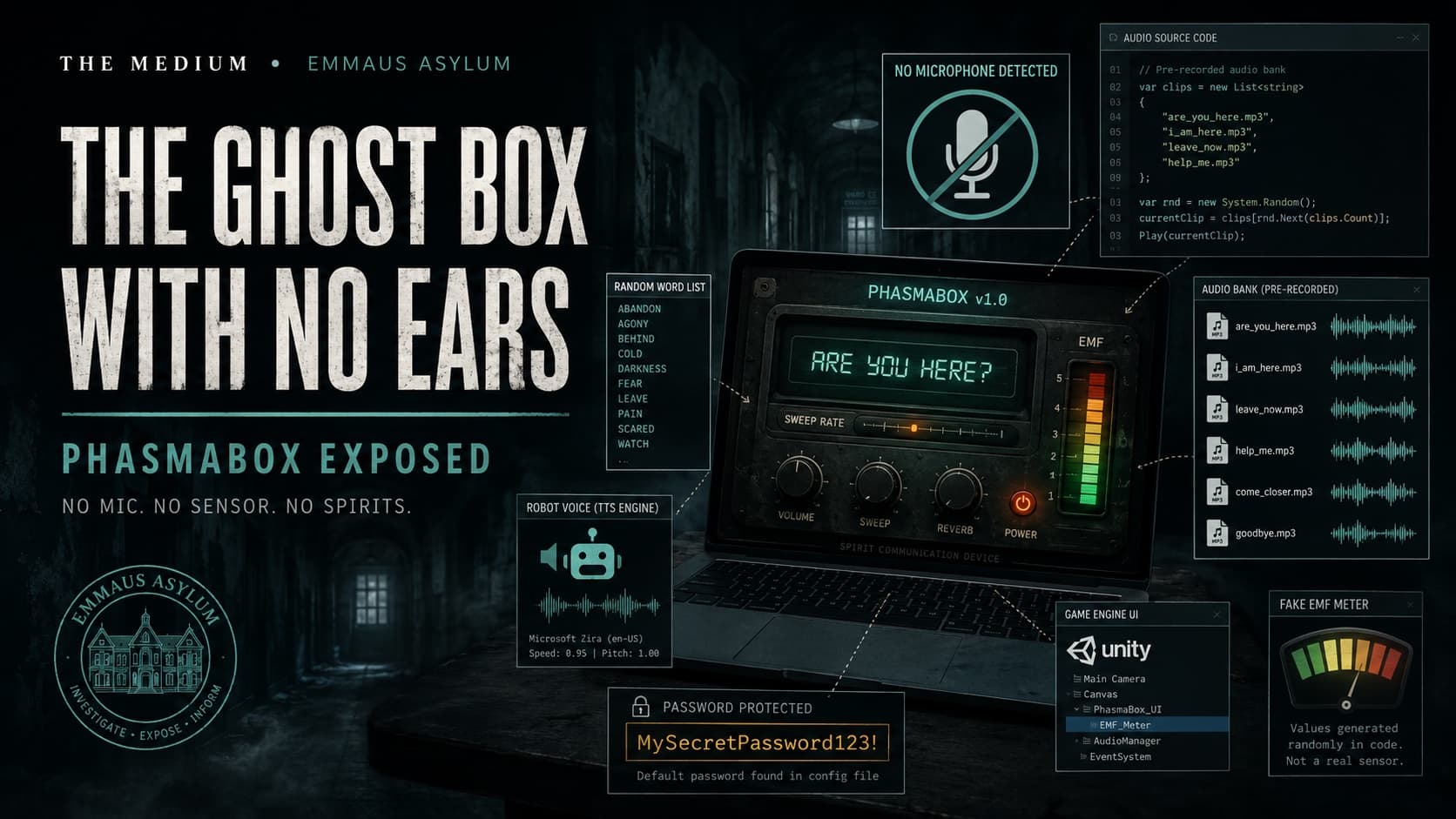
It's a video game. The "spirit voices" are pre-recorded. The password to its "encrypted" vault is literally MySecretPassword123!. And it cannot hear a single word you say — there is no microphone in it. We bought the spirit-box app ghost hunters swear by, opened it up, and read every line.
Somewhere tonight, someone is going to sit in a dark room with headphones on, ask their dead mother a question, and hear an answer.
The app that gives them that answer is called Phasmabox. It costs $24.95. It has been featured on Paranormal Lockdown and Ghost Brothers. Its maker calls it "the go-to software for exploring the unknown" and boasts that it has "dominated the field of Instrumental Trans-Communication since 2015."
We took it apart. Here is what it actually is: a video game that shuffles pre-recorded audio and reads random words out of a dictionary with a robot voice.
That's not an insult. That's the file listing.
We didn't use it. We opened it.
We bought Phasmabox 2026 Premium from the maker, copied the installer onto a Mac, and read its contents without ever running it — the way a mechanic reads an engine instead of taking the salesman's word for it. Software cannot lie about what it's made of to someone reading its own parts.
So nothing here is a feeling, a vibe, or a debate about the afterlife. It's a receipt. And we kept one for every claim we're about to make.
Claim one: it's built with a game engine
Phasmabox runs on Unity — the engine behind millions of mobile games. The "steampunk" console with the glowing needles and the flickering scan-lines is a stock retro-TV filter you can buy off a shelf. The logic that runs the whole thing is a drag-and-drop toolkit for wiring up game menus: when the button is pressed, do this.
Strip the paint and here's the machine, part by part, every one of them bought off the rack:
- The "internet radio" is a ready-made component called Radio. It streams actual live online stations — SomaFM, others — and its station list ships inside the app.
- The "spirit voices" are an off-the-shelf text-to-speech engine — the same robot that reads your GPS directions — plus a 1980s synthetic voice called SAM.
- The "sound banks" are 20 MP3 files. Ordinary music files, played by ordinary music-file code.
- The echo and reverb are the game engine's built-in effects. We'll give them this one: those are real.
Radio, a robot voice, and twenty MP3s. That is the "groundbreaking technology."
Claim two: the "spirit voices" are pre-recorded — and half are pre-reversed
The app scrubs through those twenty tracks like a hand sweeping a radio dial. They're long recordings — minutes each — which is exactly why it feels like a real spirit box hunting the airwaves.
That eerie backward-speech "reverse mode," where the dead supposedly talk in reverse? It reverses nothing. The maker simply shipped a second copy of every track, already recorded backward, and the app flips to it on command. We know because the forward and backward files are the same size down to the byte.
And the words the box "speaks"? It grabs one at random from a plain 2,126-word English dictionary — an editable text file — and the robot reads it aloud. The command that does it is named, with no irony at all, "get random word."
Here's the tell inside the tell: because that word list is just a file you can edit, the app will "channel" any word you type into it. Put your own name in the list and the spirits will say your name. A tool that will say anything you feed it has never told you anything.
Claim three: it has no ears
This is the one that ends the argument, so read it twice.
Ghost hunters use Phasmabox for the Estes method — one person blindfolded and deaf to the room, blurting out the words that "come through" while everyone else asks the questions. The entire ritual rests on one assumption: that the box is reacting to what's happening around it.
It is not. It cannot. We hunted for every possible way the outside world could get into this program, and found a locked door with no handle:
- No microphone. There is no recording code anywhere in the app. It can't hear your question. (It also isn't secretly recording you — the same fact cuts both ways.)
- No sensor. No EMF probe, no motion, no camera, no location. A Windows PC has no "energy" sensor to read in the first place. Those "EMF" and "energy" meters glowing on the screen? Animations. On a timer. They measure nothing.
- Nothing feeds the picker. We traced all twenty of the app's buttons and switches. Every one does something trivial — flip a yes/no, or tell a helper to start a sound. Not one of them looks at the world.
The only things the audio ever "sees" are a clock and a random number. We read the timers straight off the machine. The dice roll on a stopwatch, and the stopwatch does not care what you asked, who you lost, or whether you're crying.
A box that cannot receive anything — not your voice, not the room, not the question — cannot be answering any of it. No matter how real the sounds are. No matter how badly you need them to be a message.
The receipt that needs no expertise
We saved the simplest one for last, because you don't need to know a thing about computers to weigh it.
The app's audio is locked in scrambled files — a safe. To open a safe you need a password. And since the program has to open its own safe, that password is sitting inside the app, in plain English, for anyone who cares to look.
It is MySecretPassword123!
That is not a summary. That is the literal password, typed into the software in plain text, sitting right next to the files it unlocks. We didn't crack it. We read it, the same way you just did.
That is the actual craftsmanship behind "the #1 ITC software." A padlock with the combination written on the front.
So is it a scam? You decide. These aren't opinions:
We're not going to wrap the word "fraud" in a bow for you, because the facts are heavier than any label:
It is a video game. The voices are pre-recorded. The backward speech is a pre-reversed file. The "spirit words" are a random draw from a dictionary, read by a robot. There is no microphone and no sensor, so nothing you say or do can change what it plays. The "energy meters" are decorations. The vault is "protected" by MySecretPassword123!.
Every one of those is verifiable in the app's own files. Here's the part that is our opinion, and we'll stand on it: a random-audio generator is a fine toy. Dressing it as a scientific instrument, badging it with "research" and prime-time TV, and selling it — often to people chasing a voice they've lost — is where a novelty stops being harmless.
Great prop. Useless probe. Enjoy it as atmosphere if your whole crew knows it's atmosphere. But if a Phasmabox "answer" ever goes on screen as evidence of the dead, that's not paranormal investigation. That's a magic trick charging admission.
The hard part
Which brings us back to the person in the dark room, and the reason this was hard to write.
If that's you: you were not a fool. You were handed real-sounding parts — real radio, a real voice, real echo — arranged to trip the oldest circuit in the human head, the one that finds a face in the clouds and a name in the static. That circuit kept your ancestors alive. It is not a weakness. It is just not a witness.
Both of these are true at the same time: the comfort you felt was real, and the source of it was a shuffle button. Your grief was never the fake thing. The $24.95 box was.
We took this apart so you'd never again have to take anyone's word for it — not the maker's, not the TV show's, not ours. Go read the highlighted bytes yourself. They spell the whole story out loud:
M — y — S — e — c — r — e — t — P — a — s — s — w — o — r — d — 1 — 2 — 3 — !
Real radio. Real echo. A robot voice.
And no ears.
Part of our "We Took the App Apart" series on Beyond the Norm, where we buy the tools ghost hunters actually use and read their code instead of their marketing. Everything above is documented in the app's own files; the conclusions we draw from those facts are ours. We analyzed Phasmabox 2026 Premium (v2.0.06) without ever running it, and nothing here defeats the app's licensing or copies its audio — we identified the sound files by name and size only. The full technical teardown, with every claim tied to a specific file, is available on request.