Real History
The New England Vampire Panic: When Grief Opened the Graves
October 22, 2026 · The Emmaus Team · 5 min read
The Disease Behind the Legend
Across the eighteenth and nineteenth centuries, consumption, now recognized as tuberculosis, tore through New England households. The infection could cause prolonged fever, severe weight loss, weakness and bloody coughing. When one relative died and another became ill, the pattern felt uncanny. Without effective treatment, some communities interpreted the deaths as the work of a deceased family member drawing vitality from those still alive. The word “vampire” is often applied retrospectively; the people involved did not necessarily imagine the caped, fanged creature familiar today.
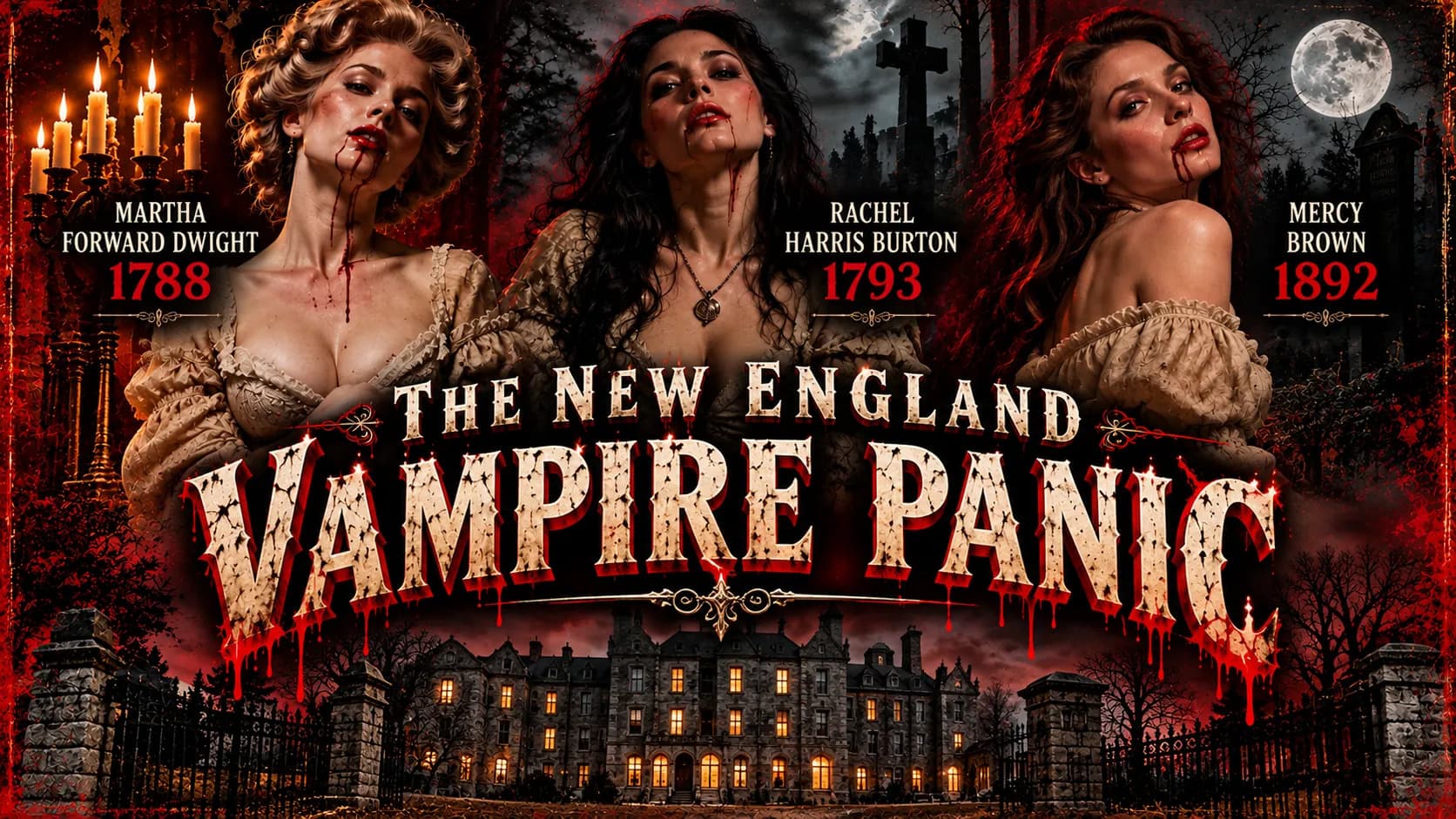
Martha Forward Dwight: Belchertown, 1788
In Belchertown, Massachusetts, Reverend Justus Forward faced a terrible crisis: three daughters had died of consumption and two others were endangered. In a letter dated July 21, 1788, he described consulting neighbors and physicians about reopening graves. He first examined the remains of his mother-in-law, Martha Dickinson. The following day, the grave of his daughter Martha Forward Dwight, who had died in 1782, was opened. Forward reported that her lungs and liver appeared more intact than expected. Those organs were placed in a separate box and buried above her coffin. His surviving letter is unusually valuable because it records the family’s reasoning close to the event. It does not establish anything supernatural. Another daughter, Mercy, died in 1789.
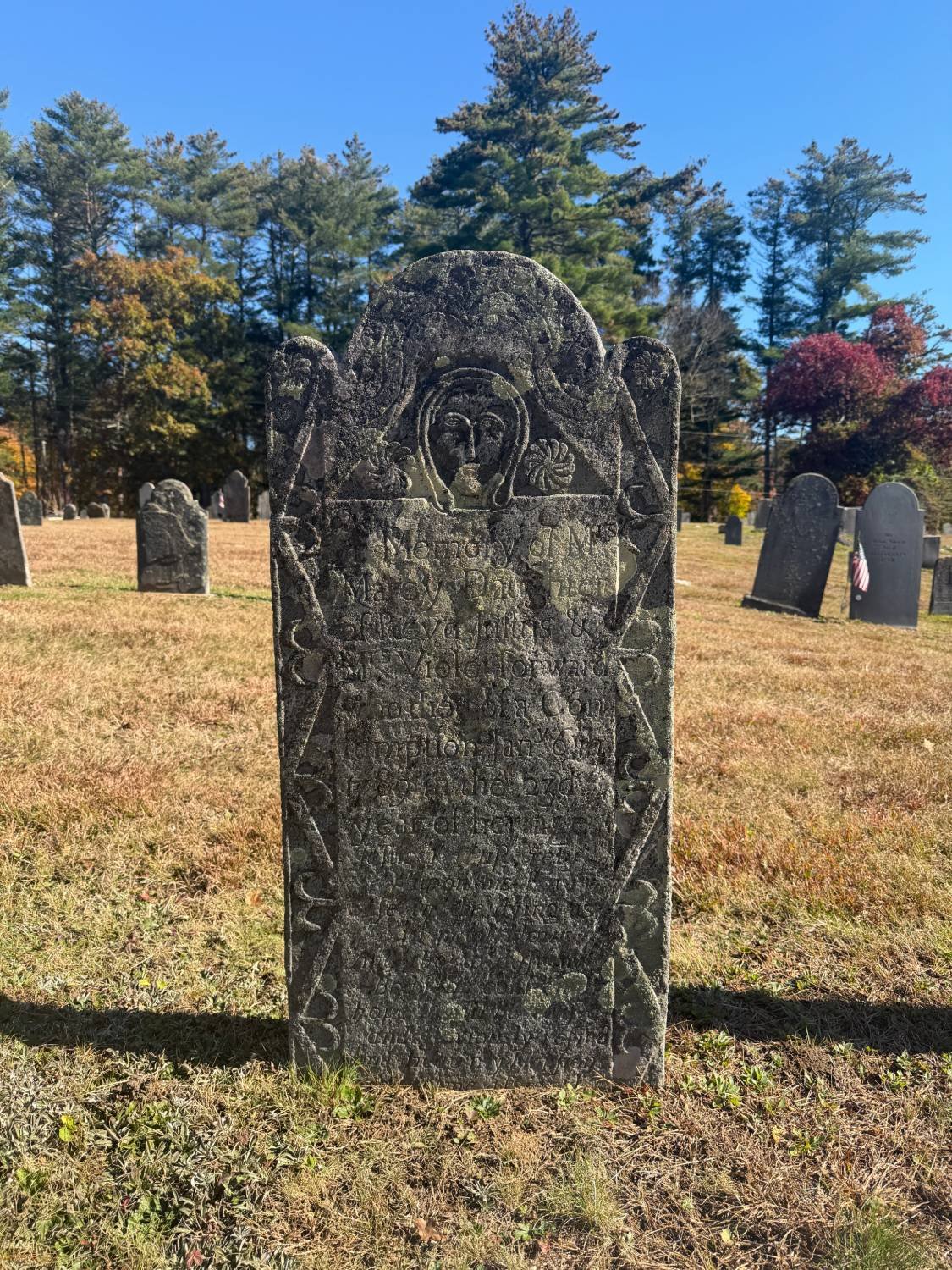
The slate marker of Mercy Forward in Belchertown, Massachusetts: “daughter of Rev. Justus & Mrs. Violet Forward, died of a consumption, January 1789, in the 22nd year of her age.” She died the winter after her sister Martha’s grave was opened. Photo: Franki Cambeletta.
Rachel Harris Burton: Manchester, circa 1792–1793
Rachel Harris Burton died young in Manchester, Vermont. After her widower Isaac Burton remarried, his second wife Hulda became gravely ill. Rachel was blamed for supposedly draining Hulda’s life from the grave. A later account by Judge John S. Pettibone describes the exhumation and burning of Rachel’s organs at Jacob Mead’s forge, with a strikingly large crowd said to be present. The exact year is disputed: Vermont Folklife and a historical marker describe the event around 1792, while other retellings place it in 1793. The grave survives at Factory Point Cemetery, where a Legends & Lore marker commemorates the case. The distinction matters: a later recollection is not the same evidentiary category as a contemporary eyewitness letter.
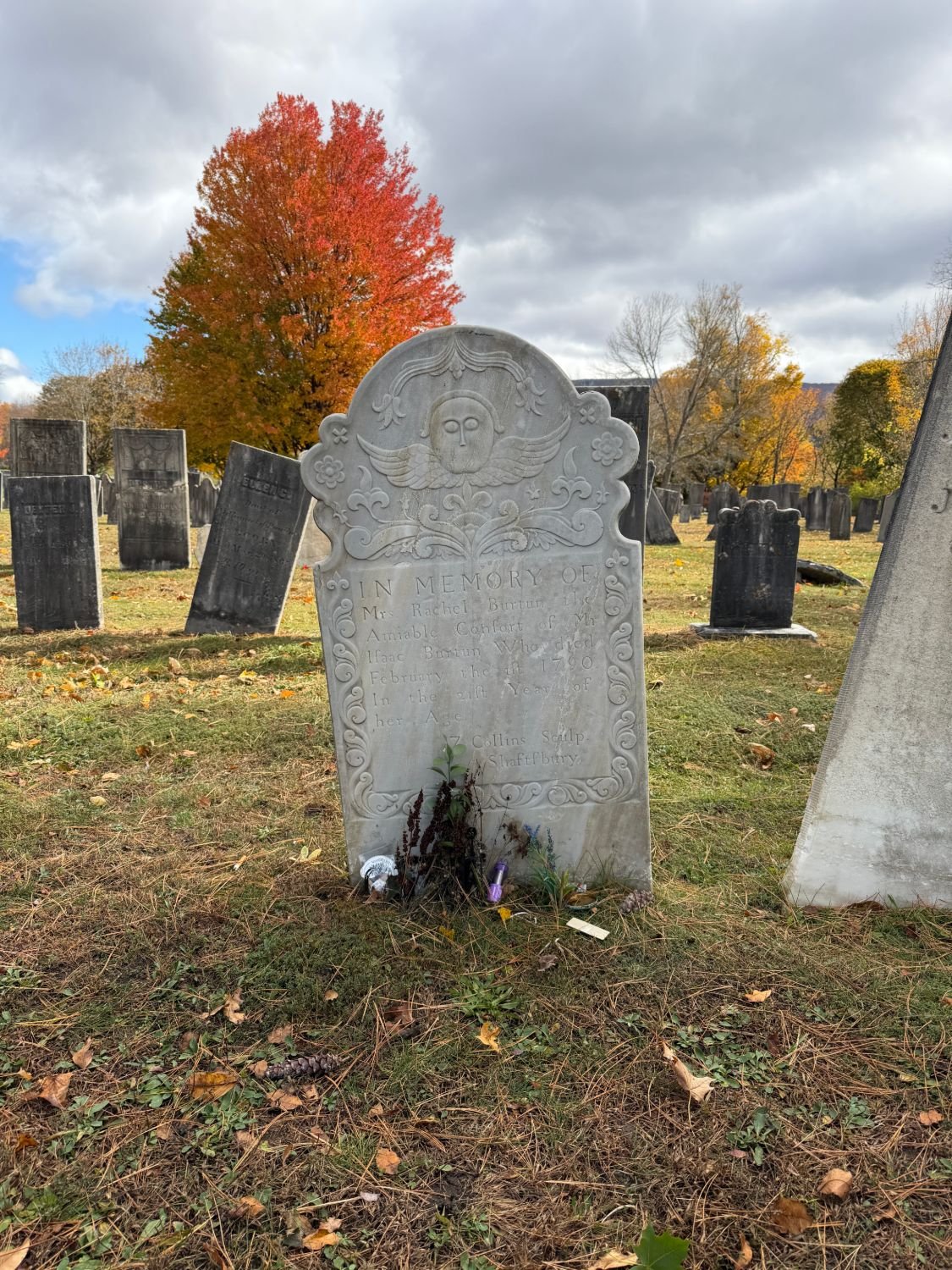
Rachel Burton’s stone at Factory Point Cemetery, Manchester, Vermont, signed by the carver Zerubbabel Collins of Shaftsbury: “the amiable consort of Mr. Isaac Burton, who died February 1790, in the 21st year of her age.” Visitors still leave small things at its base. Photo: Franki Cambeletta.
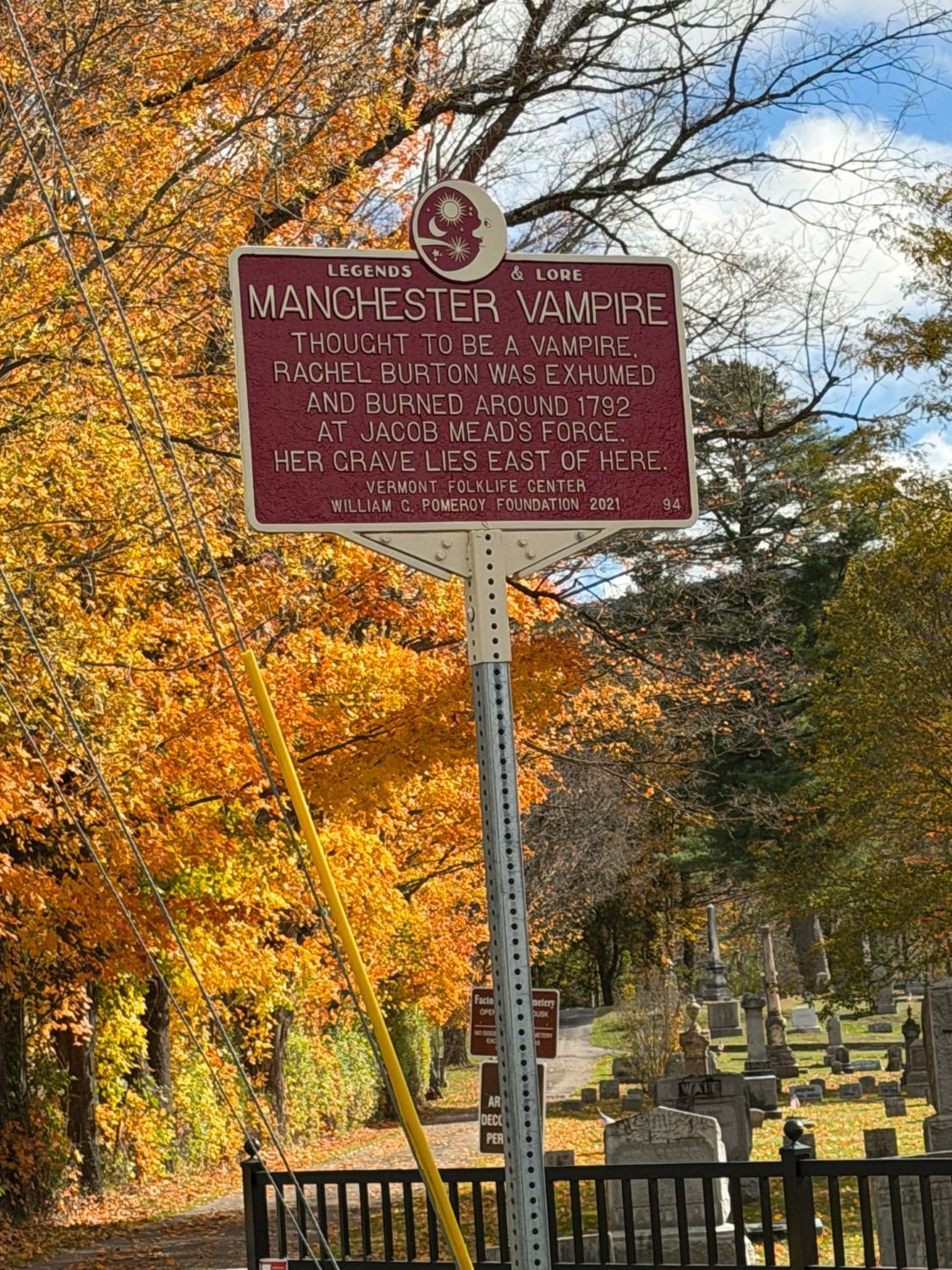
The Legends & Lore marker at the cemetery road, placed by the Vermont Folklife Center and the William G. Pomeroy Foundation in 2021. It puts the exhumation “around 1792,” the date dispute in a single line. Photo: Franki Cambeletta.
Mercy Lena Brown: Exeter, 1892
By 1892, the Brown family in Exeter, Rhode Island, had already lost Mary Eliza Brown and daughter Mary Olive to consumption. Mercy Lena Brown died in January 1892 while her brother Edwin was also desperately ill. On March 17, relatives and neighbors exhumed the women’s remains. Mercy’s body was comparatively preserved, a condition compatible with her recent death and cold-season storage. Her heart and liver were removed and burned. Accounts report that ashes were administered to Edwin as a remedy. He died that May. Mercy is buried at Chestnut Hill Baptist Cemetery. Her story became one of the most famous examples of America’s vampire folklore.
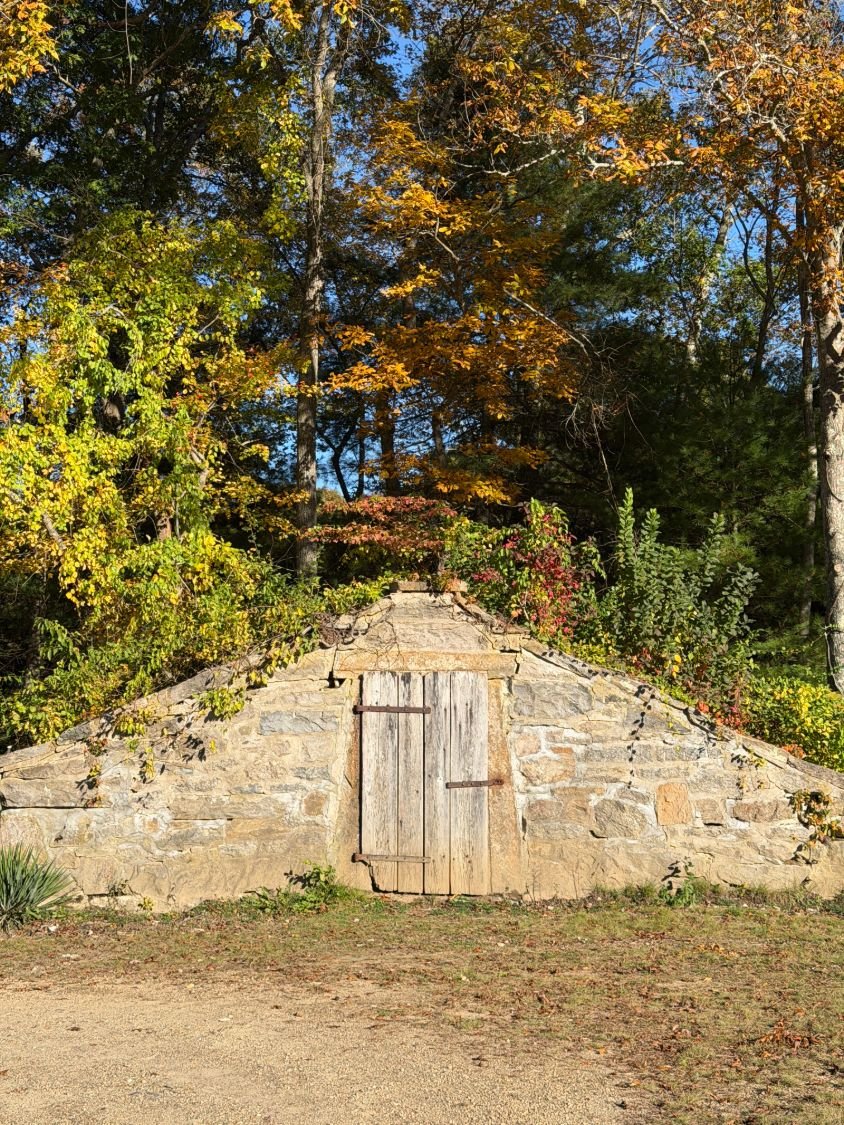
The stone receiving tomb at Chestnut Hill Cemetery, Exeter. Mercy died in January, when the ground was too frozen to dig, and her body was kept here until the spring thaw. Local lore holds that the tomb is haunted; the record holds only that a grieving family waited here for the earth to soften. Photo: Franki Cambeletta.
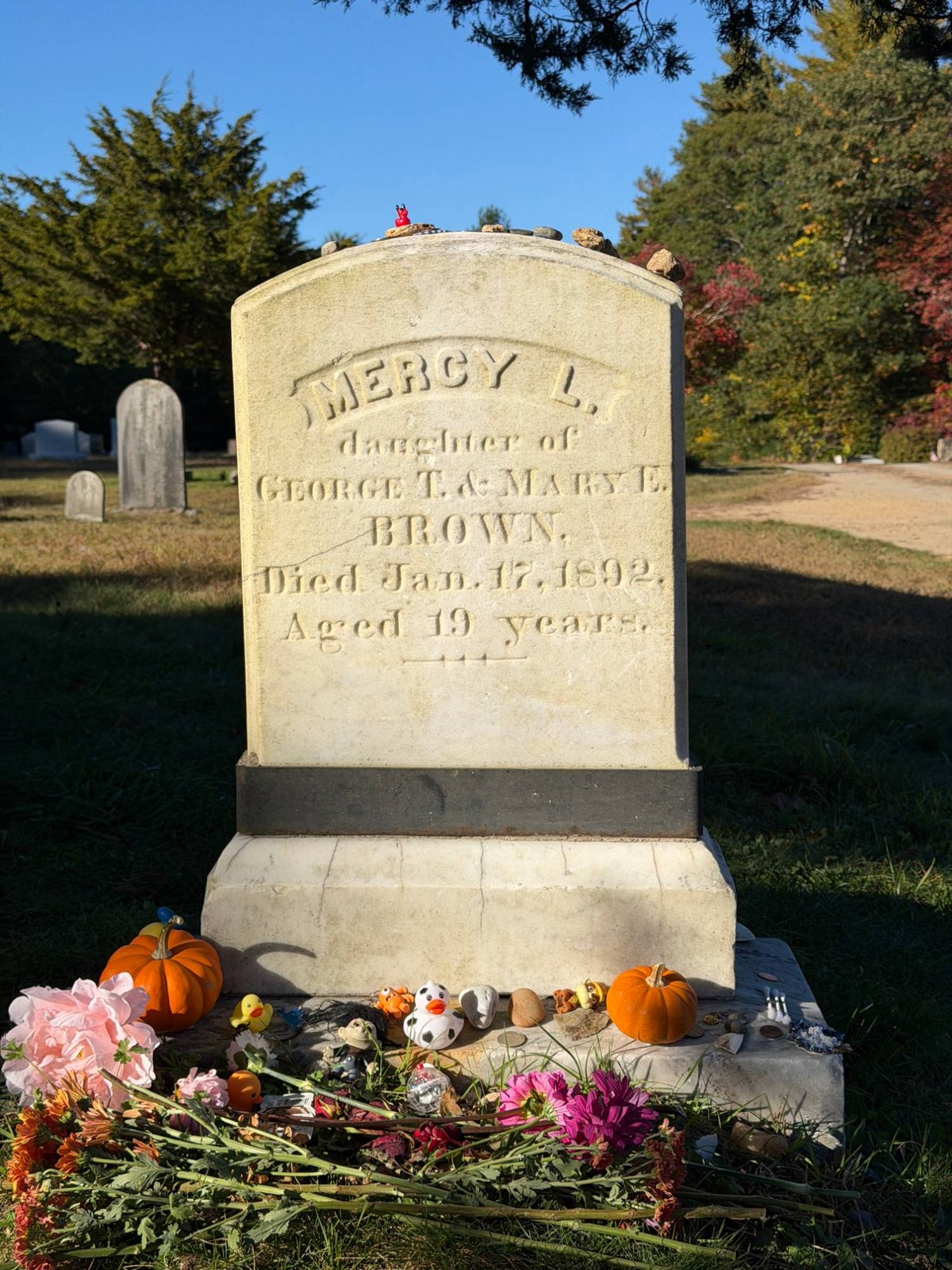
Mercy L. Brown’s stone at Chestnut Hill Baptist Cemetery, now braced with an iron band against the souvenir hunters, and heaped with the pumpkins, flowers, coins and toys that visitors leave for a girl who died at nineteen. Photo: Franki Cambeletta.
What the Graves Tell Us
These three cases should not be flattened into one supernatural claim. They involve different communities, decades and documentary records. Martha’s case is supported by her father’s letter; Rachel’s by later historical testimony and local commemoration; Mercy’s by late-nineteenth-century reporting and family records. What links them is not evidence of the undead but a pattern of desperation in the face of a contagious disease. The rituals offer a window into how people attempted to regain control when medicine could not protect those they loved.
The Human Beings Behind the Myth
It is tempting to cast these women as Gothic villains. The historical record asks us to do something harder: remember that they were daughters, wives and sisters who died of illness and whose remains were disturbed after death. Their stories are eerie precisely because the people involved were human. The New England vampire panic is not a proof of monsters. It is a record of what fear can persuade grieving people to do.
This feature accompanies the Haunted Garage podcast episode “The New England Vampire Panic,” airing Thursday, October 22, 2026, with the stories of Martha Forward Dwight, Rachel Harris Burton, and Mercy Lena Brown.
Sources and Research Notes
- Michael E. Bell, “American Vampires and the Ongoing Ambiguity of Death” (2013)
- Rhode Island Historical Society, “Have Mercy…” (2016)
- William G. Pomeroy Foundation, “Manchester Vampire”
- Vermont Folklife, “The Manchester Vampire”
- Christopher Klein, “The Last American Vampire,” HISTORY